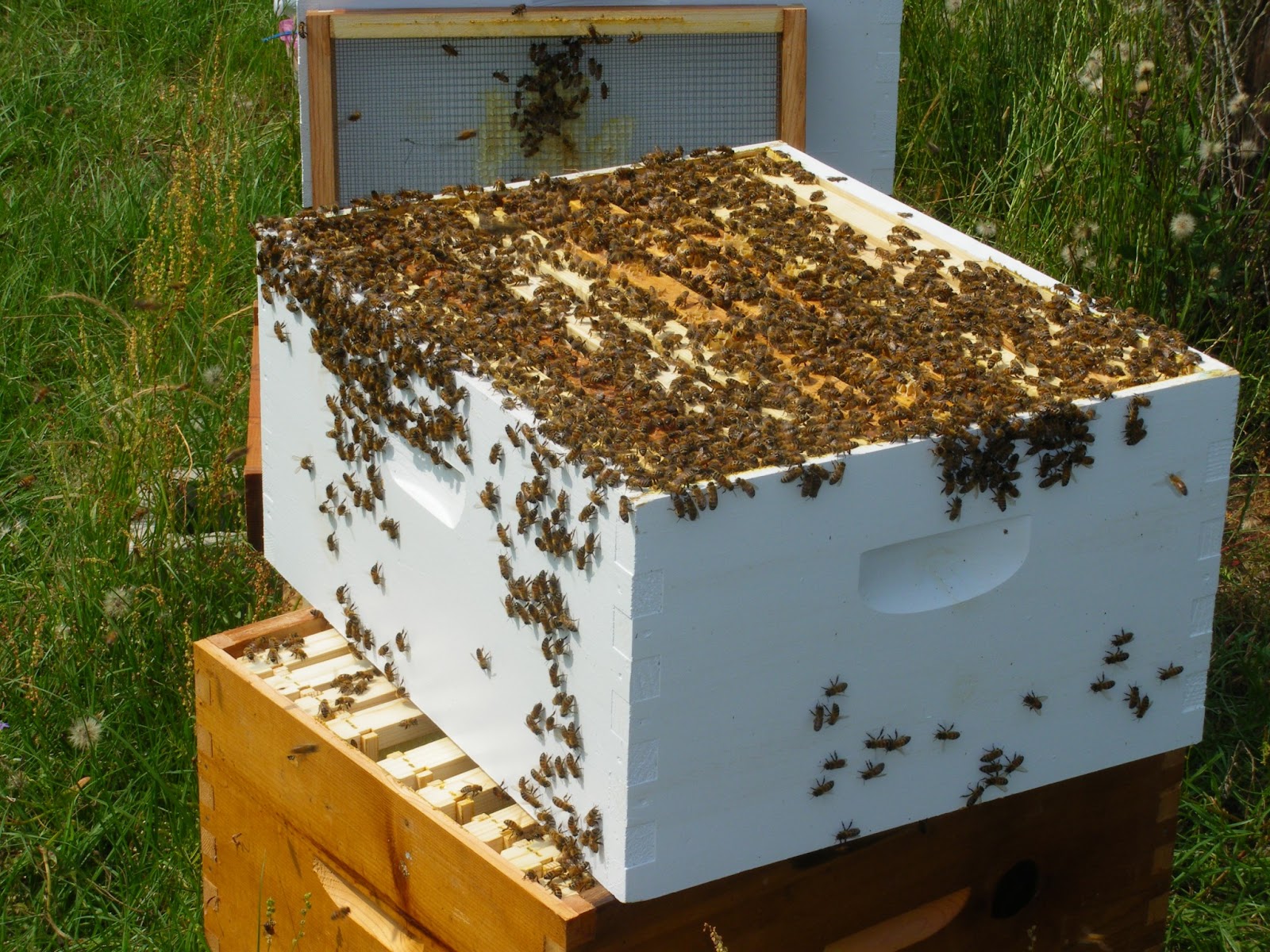
No, this is not a horror film on late night Syfi channel. Though I bet they will make one eventually.
Zombees are bees that have been parasitized by the Zombie Fly, Apocephalus borealis. The fly injects it's eggs into the abdomen of the honey bee where they develop over the next 5-14 days then the maggots crawl out of the hapless bee's body. Fun, huh?
www.zombeewatch.org is a great place for information on these gruesomely fascinating creatures. If you have bees set up a trap and do some samples. It's fun and educational and creepy.
-Robert
These are not pictures of Zombees. These are pictures I just needed a link to lol.
The bee with the amber liquid appears to have harvested some propolis and then got told to go fan the front door.
The second picture is arguably one of the coolest I have taken as you can see the pattern the wins follow by looking at the shadow of the bee.
Bees
Bee on my privet
Thursday, August 1, 2013
Wednesday, July 24, 2013
Swarms in July
A few days ago I received a call from a friend. His lawn care guy said there was a tree down in the yard at one of his houses. He goes to check it out and sure enough, half of a huge willow is laying in the back yard on the ground. He proceeds to chop it up with his chain saw until he gets close to the fence. As he get close to the fence he notices a bunch of bees flying around and calls it quits. This is where I come in.
Glen calls me and tells me he thinks there is a honey bee hive in the downed tree in his yard. I gather my bee things and a chainsaw and head over to take a look. After a brief inspection of the premises, my wife finds the colony. We pack up and tell Glen that they are indeed honey bees and that I will remove them the next day.
Early the next morning, I clear vines and small shrubs from the area where the bees are and start making the log shorter. I get to the colony and screen the end. I wait till after dark and toss the whole log in the truck.
When I get home I lay the log on the hive support where I am going to make their home and cover the entrance with leaves and such so they will reorient when they head out the next morning. I was not sure if I moved them a sufficient distance to ensure they would not head back to where the log used to be. Better safe than beeless.
About mid-day I go and check on them and notice a large glob of hive beetle larvae in the end of the log. I figure now is as good time as any and proceed to cracking the log open. Wow. I cannot even begin to explain this poor devastated hive. How they managed to keep going is beyond me. Apparently, when the branch fell, all the comb compacted into a heap on what is now the floor of the hive. I am guessing the queen died in there somewhere because I never found her and there were no eggs, just honey. There was also very little usable comb. The small hive beetle infestation was so overwhelming that I just burned the log after I coaxed the bees into a langtroth. No useable honey or anything.
To add insult to injury, after I got the bees into the langstroth hive, the bees that live in the pole on the other side of the shed began robbing them of the syrup I just fed them. To combat this, I blocked their entrance and moved the hive about 50 feet and them placed an empty 5 frame nucleus hive in it's place for any bees that were out to get into.
I left for several hours........
When I came back pandemonium was well under way. The sequestered bees decided they did not like being kept inside and removed the plug on the hive entrance. They then flew to where their hive used to be and for whatever reason, two colonies of bees were beating each other up over an empty box. Bees are apparently not as smart as I gave them credit for.
I took the 5 frame apart and shook the bees out. It was getting pretty close to dark so everyone started heading home. I then moved the hive back to it's original location so the bees could get back in. I then made a screen tunnel about 6 inches long that leads up from the entrance hole to help prevent further robbing. I figured everything would return to normal at this point. I was wrong.
At the crack of dawn (for me, around 8:30) I headed out back to check out the continuing craziness. I was not disappointed. There were bees everywhere! Oddly there were thousands on the empty five frame nuc hive. I had the front blocked off so they were just covering it. I cracked the screen a little and they started pouring in. At this point I am clueless. What the heck is going on? There are still bees all over the place in the air.
I start walking around and notice there is a big wad of bees on the ground about 15 feet from the hives. Looks suspiciously like a swarm. So I poke at it with a stick. Sure enough there is a queen in that ball of bees. I grab another empty nuc and lay it next to the swarm and herd the queen in the
hive. This was not as easy as it sounds. I then ran and made a queen cage. Upon returning I could not find the queen till she comes waltzing our of the nuc like she owns it. I try to get her in the cage and she flies off. Grrrrrr. Why do I keep bees? Why will they not bend to my will?
I go check the other nuc that I now figure is a primary swarm and there on top of it, is the queen I was trying to catch. After chasing her around for a bit I finally get her into the cage. I put her in the nuc where I want her and set it up on a ladder where the bees can find her easier.
After all that is settled, I open the hive that was robbed last night. there are dead bees all over the place. I smash a few obligatory small hive beetles and begin to sweep up the bees on the baggy feeder. Apparently a few of them were not dead and I get stung three times on two fingers. Good thing I am left handed. There appear to be enough bees left to make a go at it so I add a frame of brood from the other bee yard and close it up. I will probably add the queen I caught today to this colony as the swarm is small and they need a queen anyhow.
The ball of bees I found on the ground.
The elusive queen. Trust me, she is in there.
Nuc waiting for bees to fly in.
See the bees fanning on the porch? They are fanning queen pheremone to bring in everyone.
The logs bees' new home.
The log. Notice the smashed comb.
The entire log was just filled with larvae and beetles. I ended up burning it.
That's all till next time where hopefully I will finish my Zombee blog.
-Robert
Sunday, June 30, 2013
Bees in a Pole - the sequel
Let me tell you a story. A story of desperation, hard work and perseverance.
I begins in a wooded lot on the other side of town (not your town, mine). If you read my last post then you have a pretty good idea of what is going on here. I sometimes do silly things like for instance post things in Craigslist like "Will remove bees, swarms and hives for free.". While this generally does not lead to any real difficulties, there is always that one time.
This, is that one time.
I post the afore mentioned post on Craigslist. A few days later I get a call. A guy wants me to remove a hive of bees. Now as a beekeeper, a hive is a box where the bees live. He tells me it is a thriving colony. Great, I say to myself, some nice easy free bees and they come in a hive! After speaking with him a few minutes, I realize this is not going to be as easy as it seems. So I head to the site (You know, the wooded lot mentioned earlier) and size it up.
I arrive and check it out. Sure enough there is an old steel gate post full of bees. I think to myself, this should not be to hard and tell the guy I will get them out as soon as I can.
Several scenarios entered my mind on how to successfully remove this colony. None of them ended up being the final conclusion to this epic rehoming saga.
Here is how it went down.
A few weeks ago I show up with plans to take the bees home. The bees wanted none of this and refused to go in the pipe so I could close it off. We went home empty handed.
The night before last I head out there with some proper bee equipment (smoker and such) and smoke them. They grudgingly go into the pole and I screen it up.
Now imagine this if you will. I have my truck, an inverter (a doohickey that converts 12 volt car electricity to 115volt household electricity), and finally a recently purchased 7" angle grinder with metal cutoff wheels. Also the angle grinder was bought at Harbor Freight. Those of you who have used Harbor Freight tools probably know what is going to happen here shortly.
I did test this setup at the house prior to heading to the site. It errrr worked-ish. So at the "hive" I hook up said equipment and head over tot he post and get to cutting. Hmmm seems that when I get into it a bit it draws too much power for the inverter to handle. After turning the inverter off and on like 25 times, we give it up open up the hive and head home.
Last night we return again we screen the entrances. But this time I have a 5kw generator. Hehehe Should be no sweat, right? Wrong. After getting about 4 inches around what is a 30" circumference post the angle grinder gives up the ghost. Ahh Harbor Freight power tools. So I leave the bees screened in and head home.
This morning I arrive with the sun at Harbor Freight and trade my non functioning angle grinder in for a fresh new one. Again, we head over to the bees. Again I get to cutting. Poor bees. This time, however, everything goes according to plan and I manage to cut all the way around the post. At this point I realize the wall thickness on this thing is 1/2". No wonder it took so long to cut it. I would guess it took at least 45 minutes to cut all the way around the post. 45 long chigger and spark filled minutes. I also took breaks to allow the pole to cool so the bees would not overheat.
While I am cutting it, I slide shims in the crack to keep the post level while I am cutting and to prevent the blade from pinching. After I get it cut off, I figure I will pick it up a little and have my son slide a piece of screen under it to keep the bees in. Lets just say that the pole probably outweighed me and it did not budge.
Time to bring out the heavy stuff. I have a roll around A frame that has a 6' I-beam at the top that I can roll a chain hoist on. We drag it out of the truck and assemble it like a giant Erector Set. Now again let me set the stage here. I am on a "paved" road and the post is about 10 feet into the woods. My crane has 6" solid tires. It did not exactly roll into place but we got it. I wrap the chain fall chain around the post and clip it to itself. I begin to hoist it up. Here is where, in hindsight, I could have saved myself a load of issues. Instead of leaving it just clipped to itself, I should have tied I rope to the other side of the chain to balance the load. I didn't and pandemonium ensued. I started up with the hoist and as the last bit of uncut metal separated, the entire post quickly and violently came off the base and skewed at a 30 degree angle. There is now a nine inch hole out of which thousands of very excited bees rapidly exited. We didn't stick around to watch.
After the bees kind of calmed down, I went back in and attached a screen to the bottom of the post.
Now, I have to say, these bees are taking all this very well. I have not been stung or really harassed this whole time except once at the very start of this. I am working in shorts and a t-shirt with no veil.
Getting the gantry in the woods was hard, getting it back out with several hundred pounds of steel and bees was a miracle. Especially with a whole load of bees buzzing all over the place. I would like to take time out to thank my wife for helping get this out of the woods and on to what passes for a road in that place.
It gets easier now. We hoist it into the truck and tie it down and drive it home. After we get it home I hoist it back out and on to the ground. Unfortunately some comb was damaged and honey leaked out into the truck bed. I kind of muscle it into its temporary place (till I figure out how to get them to move into a lighter and more accessible hive) and open all the screens. They are currently repairing the damage I caused and out collecting nectar and pollen. I am glad they are finally here. I can't stop watching them. They are such a busy hive.
Here they are heavily bearding as the sun hits the post.
A close up of the beard.
A temporary resting place. I should probably level it out.
Bees!
Here they are still strapped down in the truck.
A really big gate post.
The A-frame. The chain fall is in the bucket.
Look at how thick this steel is!!
The obligatory SHBs lurking in the bottom.
Well, this is where it's at till I figure out what to do with them next.
-Robert
Saturday, June 15, 2013
Pole Bees
I got a call a couple of weeks ago about some bees in a fence post. Actually I was told I could come get a hive of bees. I was thinking "Great! A hive of bees free for the taking". After talking to the guy I begin to realize that it is not going to be so easy after all.
Apparently they are beginning construction on this land soon for a youth athletics park. Just inside the fence is an old gate. A gate the likes of which they do not make anymore. Why don't they make them anymore? Because they don't need to. The ones they made are all still in service. Even the one with the bees in it still works. I think it was for a rail road bed but I am not sure. None the less, this is the heartiest gate post I have ever witnessed.
Behold
As you can plainly see, this is not your average gate post. It harkens to the great gate posts of yore.
I went out one night a few weeks ago to size this thing up. There are tons of bees in it. It is a thriving colony. It is also surrounded by Chinese tallow and all kinds of wild trees and plants.
My first thought was to cover all the holes then connect a box to the top hole with a short length of hose and slowly fill the post with water and then just take the bees. I am not sure if would even work honestly. I then thought of a bee vac. Again due to the nature of the hive, I did not think it was going to work. A trap out might work but I am pretty sure more bees would move in next spring(As a matter of fact, I might see if I can put traps out there next spring.) plus I would then need a frame of brood and such to get that colony going.
So then I hatch a plan, a crazy plan, that involved some really big tools. I would cut it off and just take the whole thing home and work from there.
Last night I traveled to the site. I figured I would just screen the openings and cut the gate off. At that point I would start cutting the pole off at the base and just leave a couple of places to hold up the pole and I would slide screen in there and then finish off the cut. Well when we got there I swear the post grew like 40% or more. I don't remember it being so big. I started clearing around the post waiting for dark to fall so the bees would go in the post and I could screen it over. Well either it is just too hot for the bees or that pole is really full. They would not leave the outside of the pole. They were bearding heavily and also looked like they were washboarding. I think they were laughing at me personally.
As it got darker we started questioning whether or not we would even be able to get the post in the truck without mechanical help. After I finally got stung once ( I was wearing shorts and a t shirt, my usual bee keeping outfit) as I kept hitting the post with the shovel and I had a very bright headlamp on. I suppose I would have been aggravated as well. I decided that maybe I should have brought some bee keeping hardware.
We head home beeless. After sitting pondering how to move this thing, I get a few ideas. I have a gurney that I can roll around with a chain fall on it. It has decent size wheels on it but not off road stuff. I figure I could set it up over the hive on some boards and when I have the hive lifted we could just make a plank roadway to the truck. That would require some intensive manual labor and a lot of tree chopping and a few logs needed to be clear.
As I was pondering this, I notice a name on my Facebook list. Hmmmmmm This guy has a track hoe. I wonder if he feels like going on a bee crusade? I hit him up and sure enough for a nominal fee (he has to pay a driver to get the machine out there) he would gladly load it in my truck with the track hoe. Yay! Hydraulics!
So aside from some really detailed scouting and a little clearing around the hive I did not accomplish much last night. Well my doctor might argue that all the exercise did me good. Personally Louisiana humidity is pretty rough and I would have rather had the kids do all the digging.
As soon as I get a schedule together, I will make a new post hopefully detailing the successful transplant of this very active colony.
Till that fateful day,
Robert
Wednesday, June 5, 2013
A little bit of honey
I purchased my bees a few months ago, just as everything around here was starting to flower. As I mentioned I purchased a couple of nuc packages. The great thing about them is that the hive is already established and has brood and egg laying, the whole nine yards. It is just in a smaller hive. Fortunately, the time I installed my nucs into their normal hives coincided with normal growth for a colony. One of my colonies is doing great and I am about to add another deep super to it. The other is doing better and I will check on it this weekend.
I have been watching the strong hive. It has been storing a lot of honey. Most of the honey is either mixed with brood or pollen or both. However, in the top box, the outside frames looked like all honey. When I went in there last weekend, I found they had capped one side of the frame. When they have caped the comb, it means the honey is ready. Oddly the other side of the comb was not even drawn out. Feeling a bit guilty, I took the frame of honey home.
Isn't it pretty?
Unfortunately, this is a plastic foundation. So I had to scrape the comb off and crush it up a bit and let it drain overnight. To do this I took a battering bowl I have that has a rack for whatever you are battering that sits above the batter. I laid a cheese cloth on the rack then put the crushed comb on top of it. I let it filter overnight and the squeezed the remaining honey out the next day.
I managed to get about 15oz of honey from that half frame. I am pretty sure they have more now. I might add another box and pull some more in a few weeks if the weather holds up.
So here it is...my first jar of honey. Thank you bees. : )
A nice jar of honey. Wish I could share.
Robert
Monday, May 27, 2013
The Benifits of Good Photography.
As I told you in my last post, I combined my colonies to ensure the weaker one will at least supplement the stronger colony. As I was checking the colonies my photographer, my 15 year old son, was taking pictures. As a new beekeeper, I am not as familiar with what brood looks like as I should be. However, after checking the pictures he took when I got home, I realized I made a mistake.
I ran back out the next morning and separated the boxes. I then went back through the weak hive and found the queen. Whew! I was worried that they already comingled and that one of the queens were dead. Everything turned out ok. It looked like there was a decent amount of brood, not as much as I would like but not bad and the queen was laying eggs. I am hoping the bees that hatch out will expand the brood nest and increase the colony strength considerably before the end of the summer. Fortunately we have fairly long summers here so they should have plenty of time.
Here is one of the pics that changed my mind. All the open cells appear to have brood in them as well. I am pretty happy about that. I will keep an eye on this hive and keep my fingers crossed.
Till next week,
-Robert
Friday, May 24, 2013
Colony Failure
I went out today with the intention of putting the screened bottom boards on. However, things were not looking good.
Well, I tried over and over again to get my weak colony to flourish. I thought for sure what I did last week was going to work. It did not. I don't seem to have a queen. There are no eggs, no brood and no new bees. The brood I put in last week are all hatched out and they were building what looked like an emergency queen cup.
At this point, I just gave up. I combined the two hives. To combine them, I just removed the top cover from the healthy colony, stuck a sheet of news paper down and placed the two boxes of the weaker colony on top.
I am fairly certain that they will thrive now. Hopefully the increase in population will get the colony to a nice healthy level.
Unfortunately that brings my colony count to one. That means I have no fall back if something else goes wrong. I really need to catch a few swarms. I even set up a full ten frame hive as a trap out back. I should probably move some of them out of my yard and into the local woods.
Not a lot of good pics for this. But here are some pics for the sake of something to look at.
The healthy colony
Bees a buzzing
Can't tell if this is empty comb or maybe pollen?
I little bit of brood but not enough in my opinion
A very uneven pattern.
Crystal clear honey.
What appears to be an emergency queen cup.
A bee eruption from the big colony
A dead bee on the bottom board.
Subscribe to:
Posts (Atom)